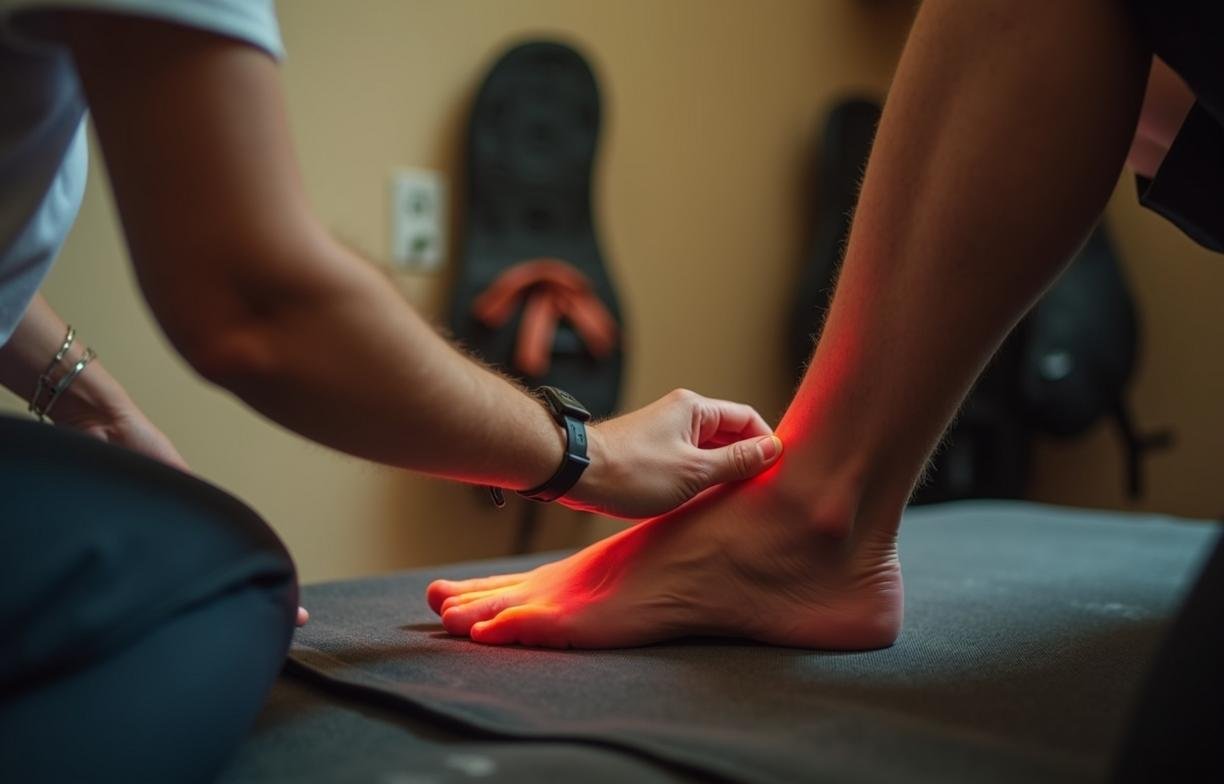
Trail running foot pain can start as a small warning on a rocky descent and become why every run ends early. A podiatrist visit is often the point where vague soreness turns into a clear diagnosis, especially when pain is one-sided, worsening, or tied to swelling.
Trail runners ask more of their feet than road runners. Uneven grades, cambered singletrack, mud, roots, and long downhill braking all change how force moves through the heel, arch, toes, and ankle. A visit is not just about “checking the shoe”; it is about matching symptoms, load, foot structure, and terrain to the most likely injury.
When trail foot pain deserves a podiatrist visit
Pain that changes your stride is a strong reason to book an appointment. The American Academy of Orthopaedic Surgeons notes that stress fracture pain usually develops gradually and worsens during weightbearing activity, often easing with rest, and that ignoring it risks a complete break.
A useful threshold is the “24-hour rule.” If foot pain rises above 3 out of 10 during a run and is still worse the next morning, reduce running and get assessed if it repeats for more than one week. Pain that causes limping, focal bone tenderness, numbness, or visible swelling should be checked sooner.
A podiatrist will also ask about recent training changes. A jump of more than 10% to 15% in weekly mileage, added elevation, or switching from smooth trails to technical terrain can overload tissue before fitness catches up.
Night pain, redness, warmth, fever, or pain after a fall need faster care. So does inability to take four normal steps, a standard often used in emergency ankle and foot assessment rules.
What the podiatrist will try to rule in or out
Trail runners commonly arrive worried about plantar fasciitis, but the pain pattern matters. Plantar fasciitis is usually worst with the first steps after sleep and often sits near the inside heel. Achilles tendinopathy tends to hurt 2 to 6 cm above the heel bone and may feel stiff early in a run.
Metatarsal stress injuries often produce pinpoint pain on top of the forefoot. Pain may worsen during toe-off or after rocky downhills. The American College of Radiology notes that early stress fractures may not show on initial X-rays, while MRI is more sensitive for early bone stress injury.
Common trail-specific causes
Downhill running increases braking force and loads the forefoot as toes press against the front of the shoe. Shoes that are too short can irritate toenails and the tips of the toes; many trail runners need about a thumb’s width, roughly 10 to 12 mm, beyond the longest toe.
Side-hill trails can overload the inside or outside of one foot. Repeated ankle rolling may irritate the peroneal tendons on the outside ankle. Deep lugs can also change ground contact, especially when moving from road shoes to 5 mm or 6 mm lug trail shoes.
Pain location gives clues
Heel pain after the first few steps of the morning points toward plantar fascia or heel fat pad irritation. Burning or tingling between the third and fourth toes can suggest a Morton’s neuroma. Pain under the big toe joint may involve sesamoid bones, which absorb high force during climbing and push-off.
A podiatrist may press specific bones and tendons, test ankle dorsiflexion, check single-leg balance, and watch walking or running mechanics. Less than about 10 degrees of ankle dorsiflexion with the knee straight can increase strain through the foot during uphill running.
What happens during the appointment
The visit usually starts with a timeline. Bring your last 6 to 8 weeks of mileage, vertical gain, longest run, shoe model, shoe age, and any race or terrain change. If you use a GPS watch, elevation and pace data can be more helpful than average weekly mileage alone.
Your podiatrist may examine shoe wear. A collapsed heel counter, compressed midsole, or heavily worn lateral heel can matter. Many running shoes lose meaningful cushioning after 300 to 500 miles, according to guidance commonly used by specialty running clinicians and retailers, though terrain and runner weight change that window.
The physical exam can include joint range of motion, tendon palpation, nerve compression tests, and strength testing. A hop test may be used when bone stress injury is suspected, but it is not enough to rule one out.
Imaging and lab work
X-rays are often used first when fracture, arthritis, bone spur, or alignment issues are possible. If symptoms are early and bone stress is still suspected, MRI may be ordered because it can show marrow edema before a fracture line appears.
Ultrasound can help assess plantar fascia thickening, neuroma, or tendon injury in the clinic. A plantar fascia thickness greater than 4 mm on ultrasound is commonly associated with plantar fasciitis in medical literature.
Blood work is not routine for every sore foot. It may be considered for recurrent stress fractures, delayed healing, or signs of inflammatory disease. Vitamin D, ferritin, thyroid markers, and inflammatory markers may be discussed if the history fits.
Which option fits your situation
Different problems need different next steps. The wrong choice can keep a minor overload injury irritated for months, while too much rest can weaken tissue without solving the cause.
| Situation | Best next step | Why it fits |
|---|---|---|
| Mild ache under 3/10, no limp, gone by next morning | Reduce trail intensity for 7 to 10 days | Many tendon and fascia overloads calm with lower force before full rest is needed |
| First-step heel pain for more than 2 weeks | Podiatrist exam and calf/plantar fascia plan | Plantar fasciitis often needs load control plus mobility and strength work |
| Pinpoint bone pain, swelling, pain hopping | Stop running and seek assessment | Stress injuries can worsen if running continues through focal pain |
| Numbness, burning, toe tingling | Footwear check and nerve evaluation | Neuroma or nerve irritation may relate to toe-box width and forefoot pressure |
| Pain after ankle twist, bruising, unstable feeling | Prompt exam, possible imaging | Ligament injury or fracture can be missed if swelling is dismissed as a sprain |
The American Podiatric Medical Association advises seeking professional care for persistent foot pain, especially when it limits normal activity. For runners, “normal activity” should include walking downstairs, standing at work, and easy jogging, not only race-pace efforts.
If you are two weeks from an event, the decision changes. Racing on a mild blister or toenail bruise is different from racing on focal metatarsal pain. Bone pain, worsening limp, or pain during walking should override the race calendar.
Treatment choices a podiatrist may recommend
Treatment depends on the diagnosis, but most plans start by reducing the specific load that provoked symptoms. That may mean flat dirt paths instead of technical descents, hiking climbs instead of running them, or replacing speedwork with cycling for 1 to 3 weeks.
For plantar fascia pain, treatment may include calf stretching, plantar fascia-specific stretching, taping, footwear changes, and progressive strengthening. Night splints are sometimes used when first-step pain is severe. A podiatrist may measure arch height, heel position, and big toe mobility before recommending inserts.
For tendon problems, complete rest is rarely the whole answer. Progressive loading is commonly used. Achilles programs often use slow heel raises, beginning with two legs and progressing to single-leg loading when pain stays controlled.
Orthotics, pads, and shoe changes
Over-the-counter inserts can help some runners when symptoms come from excess pronation, arch strain, or forefoot pressure. Custom orthotics may be considered when there is a structural issue, recurring injury, or failed simpler treatment; many clinics quote roughly $300 to $800 for custom devices.
Metatarsal pads may reduce pressure under the forefoot if placed just behind the painful metatarsal heads, not directly under them. A wider toe box can help neuroma-like symptoms when toes are compressed on descents.
Rock plates and stiffer trail shoes may protect sore forefeet on sharp terrain. But a stiffer shoe can also increase demand at the ankle or Achilles, so transitions should be gradual over several runs.
Questions to ask before you leave
Ask for a working diagnosis, not just a pain label. “Inflamed foot” is less useful than “suspected second metatarsal bone stress reaction” or “plantar fasciopathy with limited ankle dorsiflexion.”
Ask what pain level is acceptable during rehab. Many clinicians allow low tendon discomfort up to about 3 out of 10 if it settles within 24 hours. Suspected bone stress injuries usually require stricter avoidance of impact.
Ask when to return if symptoms fail to improve. A practical interval is 2 to 4 weeks for soft-tissue problems and sooner if walking pain increases. For confirmed stress fractures, return-to-run timing may start after several pain-free weeks and depends on bone location.